Demand Intelligence: Solving the Visibility Gap in Building Material Manufacturing
For decades, building material manufacturers have operated in a state of high-stakes speculation. You invest millions in brand awareness, product innovation, and lead generation, only to see that demand disappear into a "black hole" the moment it reaches the dealer network. Once a lead is handed off, visibility vanishes. Did the dealer quote the preferred spec? Was the lead followed up on within the hour, or did it sit for three days? What is the actual win rate for your newest siding profile or high-performance fastener?
This lack of dealer network visibility isn't just an operational annoyance: it is a significant drain on ROI and market share. Without hard data on how demand is being serviced at the local level, manufacturers are forced to make multi-million dollar production and marketing decisions based on anecdotal feedback from territory managers rather than real-time market signals.
The solution is demand intelligence for building materials. By leveraging a digital-first marketplace infrastructure, manufacturers can finally bridge the gap between demand creation and final sale, transforming the supply chain from a series of disconnected silos into a transparent, high-performance engine.
The Visibility Gap: Why Traditional Distribution is Failing Manufacturers
In the traditional construction supply chain, the relationship between a manufacturer and the end-user (the contractor) is mediated by a fragmented network of independent dealers. While this model provides scale, it creates a massive data deficit.
Most manufacturers currently track "sell-in" data: what they ship to the dealer. However, "sell-through" data: what the dealer actually sells to the contractor: is notoriously difficult to obtain in real-time. Even more elusive is "demand-at-intent" data: the granular details of what contractors are requesting before a quote is even generated.
This visibility gap leads to several critical business challenges:
- Misaligned Inventory: Producing materials based on historical orders rather than emerging regional demand trends.
- Unquantified Marketing ROI: Inability to prove which marketing campaigns drove high-intent RFQs that actually converted.
- Dealer Performance Blind Spots: No objective way to measure which partners are effectively capturing the demand you create.
- Lost Market Share: Failure to identify regional shifts in competitor preference until the quarterly reports arrive too late to pivot.
Defining Demand Intelligence for Building Materials
Demand intelligence is the synthesis of real-time market data, dealer performance metrics, and contractor intent. It moves beyond simple lead generation by providing the "why" and "how" behind every transaction.
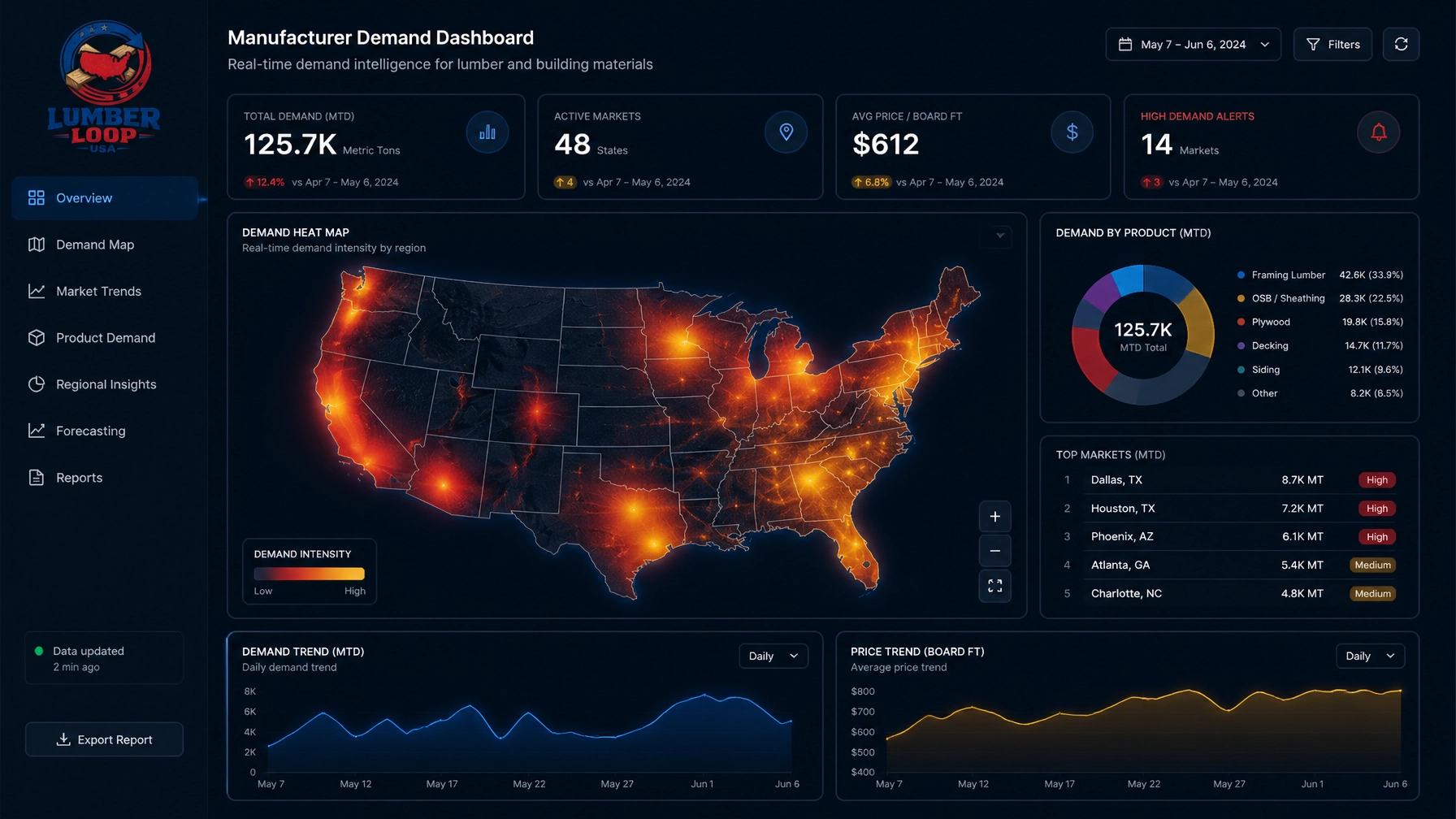
When manufacturers utilize manufacturer channel analytics, they gain a bird’s-eye view of the entire ecosystem. They can see where demand is spiking geographically, which product categories are seeing the highest volume of inquiries, and how effectively their dealer network is responding to those opportunities.

Core Pillar 1: Dealer Performance Tracking
The most significant lever for growth in a two-step distribution model is the optimization of the dealer network. However, you cannot optimize what you do not measure. Dealer performance tracking allows manufacturers to move from subjective relationships to data-driven partnerships.
By monitoring key performance indicators (KPIs) within a centralized marketplace, VPs of Sales can evaluate dealers based on:
- Lead Response Time: In the modern construction landscape, speed is the primary differentiator. Manufacturers can now track exactly how long it takes for a dealer to respond to a contractor’s RFQ.
- Quote Conversion / Win Rates: Which dealers are successfully closing the leads provided by the manufacturer? High win rates indicate a dealer who understands the product value proposition and provides competitive service.
- Product Spec Fidelity: Ensuring that when a contractor asks for your specific brand, the dealer isn’t "switching" them to a generic or competitor alternative due to stock availability or higher margins.
With this level of intelligence, manufacturers can reward high-performing dealers with more qualified leads and provide targeted support to those who are underperforming.
Core Pillar 2: Real-Time Channel Analytics
Traditional market research is often trailing data: it tells you what happened six months ago. Manufacturer channel analytics provide a leading indicator of where the market is moving next week.
For example, if a manufacturer of composite decking sees a 25% surge in RFQs for a specific colorway in the Pacific Northwest, they can adjust production schedules and reallocate inventory to that region before the shortage even hits. This level of agility is impossible in a traditional "analog" supply chain.
By integrating with platforms like Lumber Loop U.S.A., manufacturers gain access to:
- Regional Demand Heat Maps: Visualizing where building activity is intensifying.
- Category-Specific Volume: Tracking interest in specific SKUs or material types (e.g., insulation vs. siding).
- Competitive Benchmarking: Understanding how your brand’s "share of voice" in the marketplace compares to competitors in specific ZIP codes.

Core Pillar 3: Closing the ROI Loop
For Marketing Leaders, the holy grail is the ability to tie a specific campaign to a verified sale. Demand intelligence makes this a reality. When a contractor interacts with a manufacturer’s digital asset and then submits an RFQ through a connected marketplace, the path is tracked.
The manufacturer can see the entire journey:
- Demand Signal: Contractor requests specs and pricing for a specific product.
- Fulfillment Signal: Dealer receives the lead and provides a quote.
- Outcome: The quote is accepted or declined.
This allows for a true calculation of Customer Acquisition Cost (CAC) and Return on Ad Spend (ROAS) that includes the final dealer-level transaction. It transforms the marketing department from a "cost center" into a "revenue driver" with the data to prove it.
The Manufacturer Command Center: A Single Source of Truth
To operationalize these insights, VPs of Sales and Marketing need a centralized interface. The Manufacturer Command Center acts as the "brain" of the distribution network.
Instead of chasing down individual dealers for updates or waiting for monthly sales reports, executives can log into a dashboard to see the health of their entire channel in real-time. This includes monitoring the efficiency of the supply chain and identifying bottlenecks before they impact the bottom line.

The Strategic Shift: From Shipping Product to Owning Demand
The manufacturers who will dominate the 2026 construction market are those who recognize that they are no longer just in the business of making physical goods: they are in the business of managing demand data.
By prioritizing dealer network visibility and investing in demand intelligence, you ensure that your products are not just "available" but are being actively and efficiently sold by your partners. You gain the ability to predict market shifts, optimize your dealer network, and finally prove the ROI of every dollar spent on demand generation.
The "black hole" of distribution is officially closed.
Ready to gain total visibility into your dealer network?
Transform your sales and marketing strategy with real-time demand intelligence. Learn how the Manufacturer Command Center provides the data you need to grow market share and optimize channel performance.
Get matched with local dealers in minutes.
Submit your material needs and ZIP — we'll route to the closest qualified dealers in your market.
Request a Quote