Anonymous Demand: The Buyers Shopping Your Catalog Who Never Reach Your CRM

Your website can generate meaningful commercial demand without creating a single known contact.
A buyer may return to a product page several times, review technical specifications, compare product families, or click through your dealer locator. They may research availability in a specific market and leave without submitting a form. They may come back days later, continue evaluating alternatives, and ultimately engage through a dealer or distributor.
Your analytics platform may record the sessions. Your CRM may record nothing.
That gap matters.
For building material manufacturers, anonymous demand is not empty traffic. It contains product, geography, timing, and engagement signals that can help you understand where the market is moving. The challenge is that a CRM is structurally designed to manage known records: contacts, accounts, opportunities, activities, and sales history.
It is not designed to interpret the full volume of market intent that exists before a buyer becomes known.
That is where demand intelligence adds a critical visibility layer.
Anonymous Demand Is Still Commercial Demand
A visitor does not need to complete a form for their activity to have business value.
Product research can reveal what the market is considering before a formal inquiry is created. Repeat visits can indicate sustained interest. Specification downloads can show that a buyer is evaluating technical fit. Dealer-locator activity can signal that the buyer is moving from research toward availability and fulfillment.
These signals become more valuable when viewed together.
Anonymous demand may include:
- Repeated visits to a specific product or product family
- Engagement with specification pages, technical documents, or installation resources
- Dealer-locator searches by geography
- Product comparisons across categories
- Return visits within a defined buying window
- Increased interest in a product line within a territory
- Engagement that occurs before a form submission or dealer referral
- Research activity that never becomes a named opportunity
None of these signals should be treated as proof of a closed sale. They should be treated as indicators of market intent that deserve measurement and interpretation.
The strategic question is not whether every anonymous visitor should be identified. It is whether your organization can recognize meaningful demand patterns early enough to improve channel performance, marketing decisions, and market coverage.
Why Your CRM Cannot See the Entire Buyer Journey
Your CRM remains the system of record for known commercial relationships. It helps your teams manage:
- Accounts and contacts
- Open opportunities
- Sales activities
- Account ownership
- Pipeline stages
- Forecasting
- Customer history
- Documented interactions
That functionality is essential. But a CRM generally becomes useful only after a buyer, account, or opportunity has entered the system.
Before that point, commercial intent may be distributed across:
- Website analytics
- Content management systems
- Dealer-locator activity
- Campaign platforms
- Distributor communications
- Dealer systems
- Product inquiry tools
- Unstructured email or phone interactions
This creates a structural visibility gap. The CRM can tell you what is known. It cannot, by itself, explain the anonymous demand that never becomes a record.
That distinction is especially important in a channel-driven model. A manufacturer may create demand through its website and marketing programs, while the eventual commercial interaction occurs through a dealer. If the buyer never completes a manufacturer form, the original demand may remain disconnected from the dealer outcome.
The result is a limited view of your market.
The Signals Hidden in an Anonymous Catalog Visit
A single pageview is usually not enough to support a sales decision. A pattern of activity can be much more meaningful.
Demand intelligence helps organize anonymous behavior into interpretable signals. Rather than treating every website session equally, you can evaluate activity across several dimensions.
Product interest
Which products, categories, or specifications are attracting attention?
Product-level engagement can help you identify:
- Emerging demand for a new product line
- Interest in a particular application or specification
- Regions researching products that are not yet strongly represented in sales data
- Product families receiving strong attention but weak opportunity creation
- Category interest that precedes dealer inquiries
This provides a leading view of demand that complements historical shipment, order, and sell-through reporting.
Geographic intent
Where is the activity occurring?
Geographic signals can help you compare:
- Product interest by territory
- Dealer-locator activity by market
- Regions with high research activity but limited opportunity visibility
- Areas where demand is rising faster than channel performance
- Markets where dealer coverage may not match buyer interest
A regional demand pattern does not automatically indicate a revenue opportunity. It does, however, give your sales and channel teams a more informed basis for evaluating coverage and performance.
Timing and recency
When is the activity happening, and is it continuing?
A buyer who visits once may be gathering general information. A buyer who returns repeatedly, reviews several related pages, and then searches for a dealer is showing a different pattern.
Useful timing signals can include:
- Recency of product engagement
- Frequency of repeat visits
- Sequence of pages viewed
- Time between research and dealer-locator activity
- Changes in interest after a campaign or product launch
- Activity that increases before a known buying period
The value is not in assigning an arbitrary score to every action. The value is in creating a consistent framework for distinguishing passive traffic from sustained commercial interest.

Dealer-Locator Clicks Are a Channel Signal, Not a Dead End
A dealer locator is often treated as a utility: a way to help a buyer find a nearby source of supply.
For manufacturers, it can also be a high-value channel signal.
When someone searches for a dealer, they may be moving beyond product education and toward local availability, pricing, or fulfillment. If that interaction ends without a tracked form completion, the demand may disappear from your reporting.
You may not know:
- Which product prompted the dealer search
- Which geography was involved
- Whether the buyer contacted a dealer
- Whether the dealer responded
- Whether the requested product was available
- Whether the buyer received a quote
- Whether the product was substituted
- Whether the opportunity resulted in sell-through
That does not mean every locator click is a qualified opportunity. It means the interaction should not be discarded as anonymous noise.
With the right demand intelligence layer, dealer-locator activity can be evaluated alongside product interest, geography, repeat engagement, and downstream opportunity data. This helps you determine where buyer intent is being created and whether your channel is equipped to convert it.
Demand Intelligence Complements Your CRM
The answer is not to replace your CRM. Your CRM should continue to manage known records and relationship activity.
Demand intelligence operates above the CRM by interpreting signals that exist before, around, and outside of those records.
A connected model can look like this:
- Website analytics capture digital engagement.
- Demand intelligence interprets product, geographic, and timing signals.
- The CRM manages known accounts, contacts, and opportunities.
- Dealer data reveals routing, response, and channel execution.
- Quote outcomes support win-rate and lost-sale analysis.
- Sell-through data connects demand to market performance.
This creates a broader operating view without forcing your CRM to become something it was never designed to be.
The demand intelligence layer can help you identify anonymous activity that should be monitored, matched to an existing account, routed to a channel owner, or used to inform a market-level decision. It can also help you understand which anonymous patterns eventually become known opportunities and which disappear before the channel can act.

The Executive Questions Anonymous Demand Can Answer
Once anonymous activity is treated as a measurable demand signal, your leadership team can ask more useful questions.
For example:
- Which product categories are attracting sustained research activity?
- Where is product interest strongest by geography?
- Which dealer-locator interactions are not becoming trackable opportunities?
- Are repeat visitors converting at a higher rate than one-time visitors?
- Which campaigns generate product engagement but little channel progression?
- Where does demand appear strong while dealer response or win rates remain weak?
- Which markets show early interest in a product before it appears in sales reporting?
- How much of your website-generated demand has a documented channel outcome?
- Where are buyers engaging with your brand but ultimately selecting another product?
- Which signals should be shared with sales, marketing, and channel leadership?
These questions move your organization from reporting activity to interpreting demand.
They also support more disciplined decisions around dealer development, territory planning, campaign investment, product positioning, and market expansion.
Turn Anonymous Intent Into Measurable Opportunities
Anonymous demand should not be treated as a replacement for first-party relationships or direct sales engagement. It is an early visibility layer that helps you understand what happens before the relationship becomes formal.
The manufacturers best positioned to act on this information will establish clear definitions for:
- Meaningful product engagement
- Repeat research behavior
- High-value geographic activity
- Dealer-locator intent
- Opportunity creation
- Channel progression
- Response-time performance
- Win and loss outcomes
- Product substitution
- Sell-through visibility
From there, you can connect demand signals to the systems your teams already use.
Marketing can evaluate whether campaigns create relevant product interest. Sales can prioritize accounts and markets showing meaningful activity. Channel leaders can compare demand creation with dealer response and win rates. Executives can identify where market share is being lost between brand engagement and commercial outcome.

Find the Demand Your CRM Does Not Capture
Your CRM is not failing because it does not contain every anonymous visitor. It is doing the job it was built to do: managing known records and relationships.
The gap exists because your buyer journey begins before a known record is created.
That is why demand intelligence matters. It gives you a structured way to interpret anonymous catalog research, repeat visits, specification engagement, dealer-locator activity, and regional product interest. It helps connect those signals to dealer performance, opportunity tracking, win rates, and sell-through data.
Lumber Loop helps building material manufacturers create a clearer visibility layer across market demand and channel execution. By connecting demand signals with routing, dealer activity, opportunity progression, and outcomes, you can better understand where interest is being created and where growth is being lost.
Learn more about demand intelligence for building material manufacturers or explore how Lumber Loop helps solve the visibility gap.
Get Your Free Lead Leakage Scorecard
How much of your manufacturer-generated demand becomes visible, trackable, and measurable after a buyer engages with your catalog?
Use the Free Lead Leakage Scorecard to evaluate the visibility gaps across your website, dealer locator, CRM, and channel handoff.
Identify where anonymous demand disappears, and where better demand intelligence can help you recover measurable opportunities.
Get matched with local dealers in minutes.
Submit your material needs and ZIP — we'll route to the closest qualified dealers in your market.
Request a QuoteMore insights
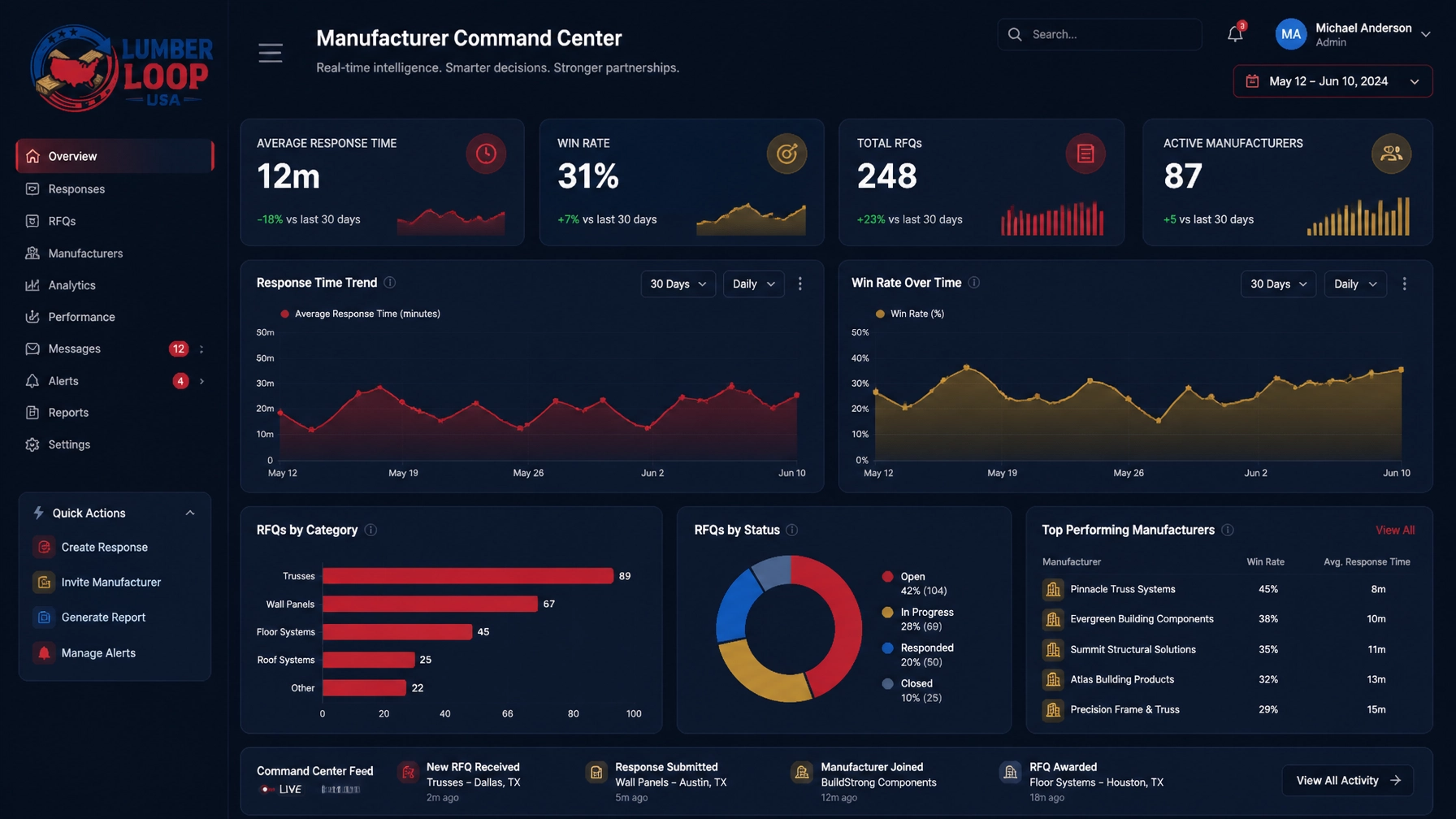
Lead Leakage Is Costing You More Than You Think: Why a CRM Alone Cannot See the Full Buyer Journey
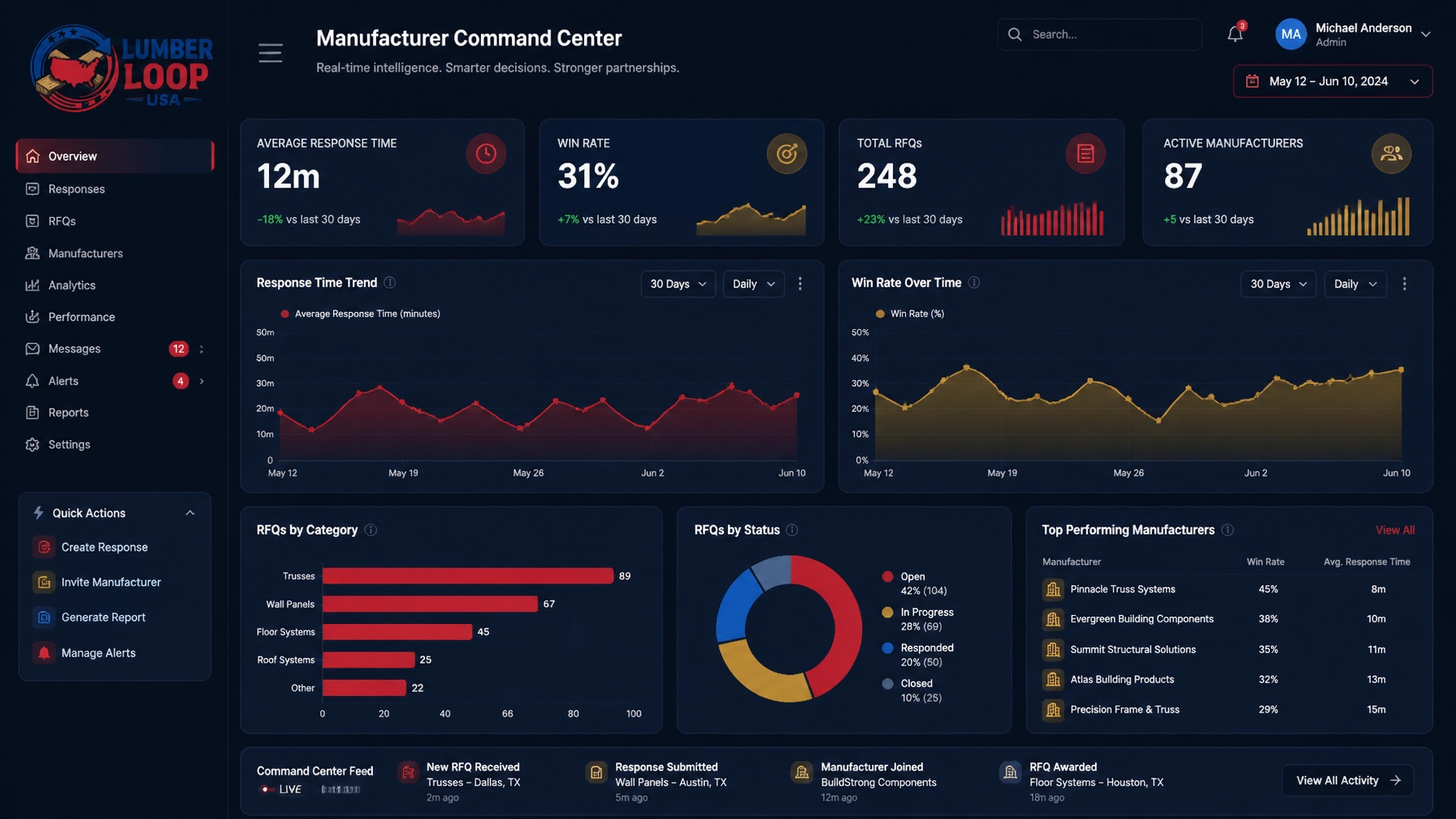
Win-Rate Analytics for Manufacturers: Finding the Dealers Who Actually Close Your Demand