Lead Leakage Is Costing You More Than You Think: Why a CRM Alone Cannot See the Full Buyer Journey
Your website can generate demand without giving your organization a clear view of what happens next.
A specification request may reach a dealer. A prospective buyer may click through a dealer locator but never submit a form. A quote may be created, revised, substituted, or lost without the manufacturer ever seeing the outcome. A high-intent visitor may return several times before engaging with a sales team, leaving only fragmented signals across analytics platforms, inboxes, dealer systems, and CRM records.
This is lead leakage.
For building material manufacturers, lead leakage is not limited to unassigned forms. It is the loss of visibility between demand creation and channel outcome. When that visibility disappears, you cannot reliably measure dealer performance, identify lost sales, attribute marketing impact, or understand where your product is being replaced by a competitor.
A CRM remains essential. But it is not designed to see the entire market-facing buyer journey.
To manage channel performance effectively, you need a demand intelligence layer that works above and beyond the CRM.
A CRM Records Known Activity. Demand Intelligence Reveals Unseen Demand.
Your CRM is built to manage relationships, contacts, opportunities, tasks, and sales activity. It helps your teams understand what is known about a buyer or account.
That value should not be understated.
The challenge is that much of the demand generated by a manufacturer website is not immediately associated with a known contact or structured opportunity. A CRM may not capture:
- Anonymous product research and repeat website visits
- Dealer-locator clicks without form completion
- Untracked referrals from dealers, distributors, or third-party platforms
- Product and specification page engagement
- Response-time gaps after a dealer handoff
- Quotes that are created outside the manufacturer’s systems
- Lost opportunities with no standardized reason
- Product substitutions at the dealer level
- Sell-through activity after the initial lead is routed
This creates a visibility gap.
Your CRM may show the opportunities your teams know about. Demand intelligence helps reveal the demand your organization is generating, where it is going, how it is progressing, and where it disappears.
That distinction is central to modern manufacturer channel analytics.
Where Lead Leakage Happens Across the Manufacturer Website
Lead leakage often begins before a lead enters the CRM.
A visitor may arrive through a paid campaign, organic search, a specification resource, or a dealer referral. They may review product information, compare solutions, search for availability, and use a dealer locator. If the journey ends without a tracked form submission, the activity may be classified as anonymous traffic rather than commercial intent.
The manufacturer sees website sessions. The dealer may see a potential buyer. Neither has a complete view of the opportunity.
Common leakage points include:
- Dealer-locator interactions: A visitor identifies a nearby dealer but does not submit a request that can be routed or monitored.
- Incomplete handoffs: A request is sent to a dealer, but the manufacturer cannot confirm whether it was accepted, contacted, quoted, or closed.
- Untracked referrals: A dealer, distributor, representative, or campaign generates demand that is not tied back to the original source.
- Disconnected quote activity: A dealer provides pricing through a separate system, leaving the manufacturer without visibility into quote progression.
- Unreported losses: A buyer chooses another product, changes specifications, or abandons the project without a structured reason being captured.
- Post-handoff silence: The manufacturer loses sight of the opportunity the moment it enters the dealer network.
Each gap may seem small in isolation. Together, they make manufacturer ROI tracking incomplete.
The Dealer Handoff Is the Highest-Risk Visibility Gap
Manufacturers invest heavily in creating market demand. They build awareness, support specifications, fund campaigns, produce product content, and drive traffic to their websites.
But the buyer journey often becomes opaque at the exact moment demand enters the dealer channel.
At that point, manufacturers may not know:
- Which dealer received the opportunity
- Whether the dealer responded within an appropriate timeframe
- Whether a quote was issued
- Whether the requested product was available
- Whether the buyer selected a competing brand
- Whether the specification changed
- Whether the transaction ultimately reached sell-through
This is why a dealer locator should be treated as more than a directory. It is a channel-entry point and a critical source of demand intelligence.
A locator that only displays dealer names and contact information may help a visitor find a supplier. It does not necessarily help the manufacturer understand demand, monitor opportunity progression, or measure channel outcomes.
For greater dealer network visibility, the handoff must become measurable.
What Demand Intelligence Adds Above the CRM
Demand intelligence does not replace your CRM. It connects the market signals and channel activity that the CRM may not capture on its own.
A strong demand intelligence layer can help you understand four connected dimensions of performance:
1. Market demand
See where buyers are showing interest in your product categories, regions, and applications: even when they have not yet become known contacts.
Relevant signals may include:
- Geographic demand patterns
- Product and category interest
- Dealer-locator activity
- Request volume by source
- Repeat engagement
- Regional changes in buyer intent

2. Opportunity progression
Understand what happens after demand is captured and routed.
This includes tracking:
- Assignment and routing
- Dealer acceptance
- Response time
- Quote creation
- Quote status
- Follow-up activity
- Win and loss outcomes
- Lost-opportunity reasons
This creates a more complete foundation for opportunity management for manufacturers. Instead of reporting only on leads created, you can evaluate how opportunities move through the channel.
3. Dealer performance
Dealer performance should be measured by more than sales volume or geographic coverage.
Channel leaders also need visibility into:
- Response-time consistency
- Quote engagement
- Opportunity follow-through
- Win rates
- Product availability
- Lost-opportunity patterns
- Handoff completion
- Sell-through feedback
This helps distinguish between a market with weak demand and a dealer network that is failing to convert available demand.
4. Channel outcomes
The ultimate question is not whether someone visited your website. It is whether market demand became a meaningful commercial outcome.
Demand intelligence can help connect initial interest to:
- Dealer-sourced quotes
- Product selection
- Brand preference
- Substitution activity
- Closed opportunities
- Sell-through data
- Regional revenue contribution

The Executive Metrics a CRM Alone May Not Provide
A CRM can report on the records inside it. Demand intelligence expands the questions your leadership team can answer.
For example:
- How much demand is being generated in each market?
- Which dealer-locator interactions are not becoming trackable opportunities?
- Which dealers respond consistently, and which create response-time gaps?
- Where are opportunities being lost after the manufacturer handoff?
- Which regions show strong product interest but weak dealer conversion?
- How often are requested products substituted?
- Which marketing sources generate the most actionable demand?
- What portion of channel activity has a documented outcome?
- Where is sell-through visibility strongest: and where is it absent?
These insights support more effective manufacturer ROI tracking. They help marketing leaders evaluate demand quality, sales leaders improve channel execution, and executives identify where growth is being lost between awareness and revenue.
Build a Connected Visibility Layer Across Your Channel
The most effective architecture is not CRM versus demand intelligence. It is CRM plus demand intelligence.
Your CRM should continue managing known accounts, contacts, sales activities, and relationship history. Demand intelligence should provide the broader visibility layer across website behavior, market intent, dealer routing, opportunity progression, and channel outcomes.
Together, they create a more complete operating model:
- Website analytics show engagement.
- Demand intelligence interprets commercial intent.
- CRM manages known relationships and activities.
- Dealer network data reveals channel execution.
- Quote and outcome data supports win/loss analysis.
- Sell-through signals connect demand to market performance.

Without this connected view, lead leakage remains difficult to diagnose. You may increase media spend when the real issue is dealer response. You may recruit more dealers when the real issue is routing. You may revise product messaging when the real issue is substitution or availability.
Better visibility leads to better decisions.
Find What Your CRM Cannot See
Lead leakage is not simply a marketing problem or a sales problem. It is a channel visibility problem.
If demand disappears after a website interaction, dealer-locator click, or handoff, your organization loses the ability to understand what happened: and why. Over time, those blind spots make it harder to improve dealer performance, protect market share, and prove the return on manufacturer demand creation.
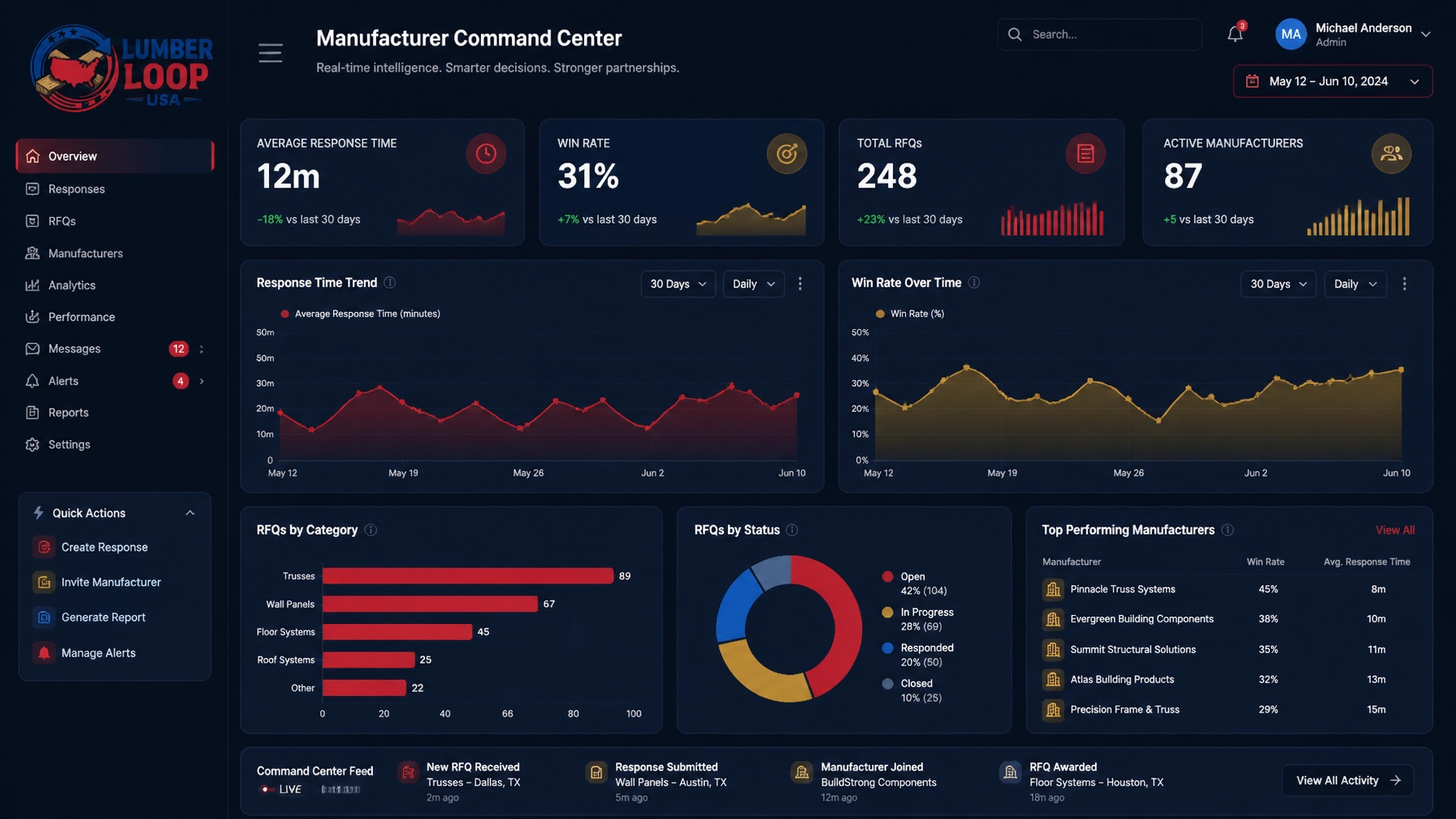
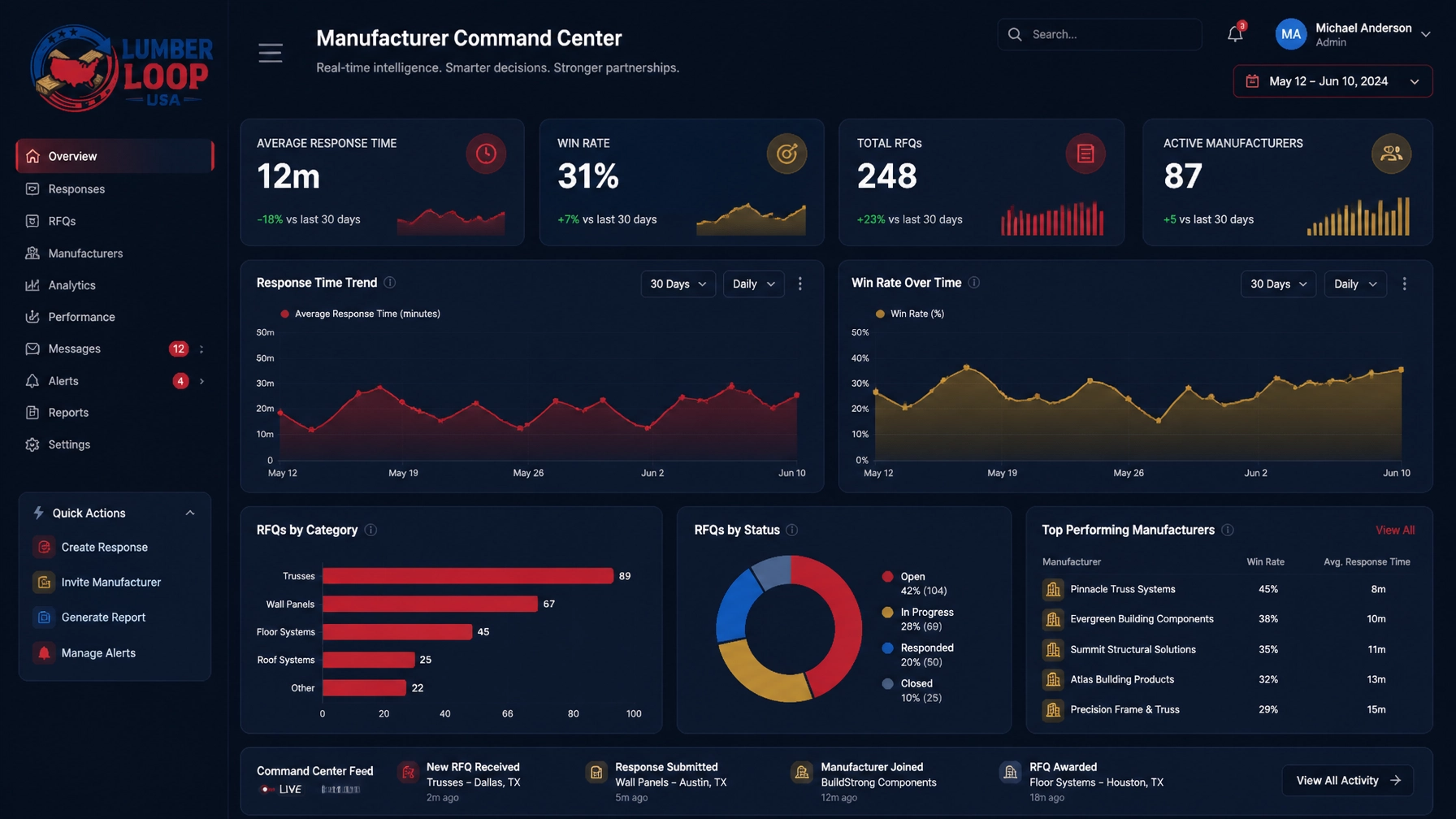
Lumber Loop helps manufacturers connect demand signals with dealer and channel outcomes. Our platform provides visibility into demand, routing, response times, opportunity progression, win and loss activity, and dealer performance: so you can see what happens after demand enters the channel.
Learn what your CRM cannot see. Explore Lumber Loop’s demand intelligence for building materials and uncover where lead leakage is costing your organization growth.
Learn more about demand intelligence for building material manufacturers or explore how Lumber Loop helps close the visibility gap.
Get matched with local dealers in minutes.
Submit your material needs and ZIP — we'll route to the closest qualified dealers in your market.
Request a Quote